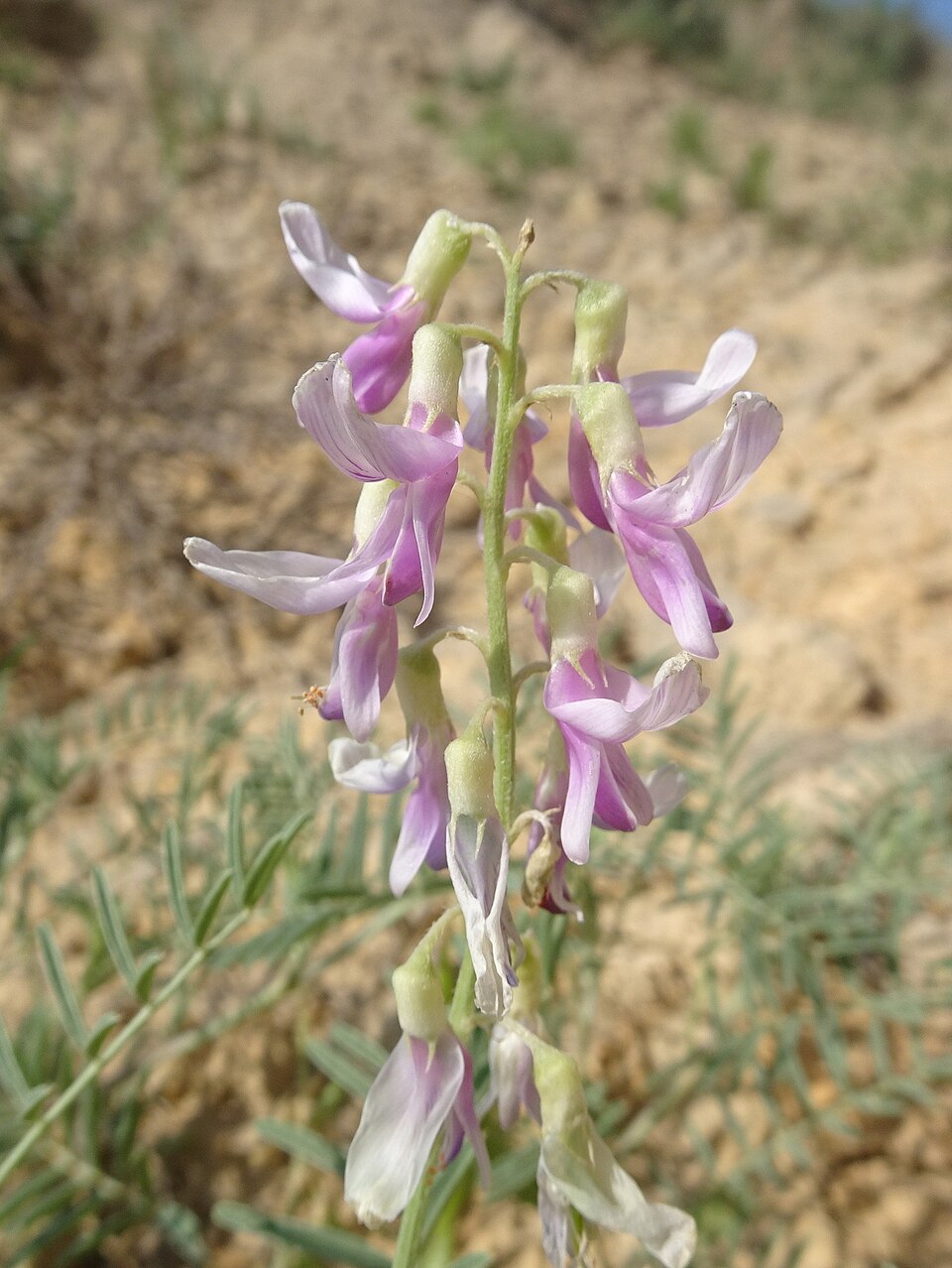

Astragalus racemosus
creamy poison-vetch
Accumulation profile
- Substrate
- Seleniferous soils
- Habitat
- Prairie over selenium-rich shale
- Distribution
- North America (Great Plains)
- First reported
- 1937 · Knight & Beath
- Verification
- review-cited
Description & ecology
Another indicator milkvetch of seleniferous ground, whose presence historically signalled selenium-rich soils to ranchers and prospectors.
Audit correction 2026-09-06: the previously stored 14,000 µg/g (attributed to 'Beath et al. 1936') matches no source. The documented native-soil figure is ≤14,920 µg/g Se, traced through two independent open-access reviews (White 2016, Annals of Botany 117:217–235, Table 1; van der Ent et al. 2023, Annals of Botany 132:349–361) to the ultimate primary Knight & Beath (1937, University of Wyoming Agricultural Experiment Station Bulletin 221), which is not digitized and could not be read at source — hence the record stays review-cited, with the value corrected to the documented 14,920.
van der Ent et al. (2023, Table 2) additionally report 28,500 ± 3,600 µg/g Se in OLD leaves under glasshouse selenate/selenite dosing — a dosed value, not comparable to field maxima.
References
- Knight, S. H., & Beath, O. A. (1937). The occurrence of selenium and seleniferous vegetation in Wyoming. University of Wyoming Agricultural Experiment Station Bulletin, 221, 1–64.
- White, P. J. (2016). Selenium accumulation by plants. Annals of Botany, 117, 217–235. doi:10.1093/aob/mcv180
- Reeves, R. D., Baker, A. J. M., Jaffré, T., Erskine, P. D., Echevarria, G., & van der Ent, A. (2018). A global database for plants that hyperaccumulate metal and metalloid trace elements. New Phytologist, 218, 407–411. doi:10.1111/nph.14907