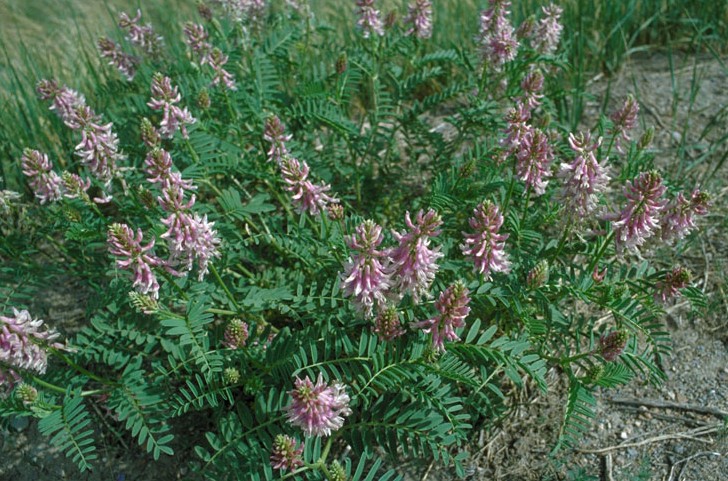

Astragalus bisulcatus
two-grooved milkvetch
Accumulation profile
- Substrate
- Seleniferous shale soils
- Habitat
- Arid rangeland over selenium-rich rock
- Distribution
- North America (western)
- First reported
- 2015 · Sura-de Jong et al.
- Verification
- primary-measured
Description & ecology
A classic selenium accumulator of the American West, converting selenium into organic forms; historically important in livestock selenosis ('blind staggers').
Provenance flag resolved 2026-08-09 (raised 2026-07-26): the former 14,900 µg/g was untraceable and was almost certainly a mis-carry of the A. racemosus native-soil figure (≤14,920; Knight & Beath 1937 via van der Ent et al. 2023). The stored 13,685 µg/g is a leaf measurement from a wild plant on native seleniferous soil (Pineridge Natural Area, Colorado; Sura-de Jong et al. 2015, open access, read at source: 'root, stem and leaf Se levels were 813, 9158, and 13,685 mg kg⁻¹ DW'), independently corroborated by van der Ent et al. (2023): 'A. bisulcatus … ≤13,685 µg g⁻¹ … growing in native soils'.
The '28,500 µg/g' sometimes attributed to this species (e.g. 'Alford 2014' in a 2026 review) is a double mis-citation: it is A. racemosus OLD leaves under glasshouse selenate/selenite dosing (van der Ent et al. 2023, Table 2); Alford et al. (2014) contains no tissue-Se maxima at all.
References
- Sura-de Jong, M., Reynolds, R. J. B., Richterova, K., Musilova, L., Staicu, L. C., Chocholata, I., Cappa, J. J., Taghavi, S., van der Lelie, D., Frantik, T., Dolinova, I., Strejcek, M., Cochran, A. T., Lovecka, P., & Pilon-Smits, E. A. H. (2015). Selenium hyperaccumulators harbor a diverse endophytic bacterial community characterized by high selenium resistance and plant growth promoting properties. Frontiers in Plant Science, 6, 113. doi:10.3389/fpls.2015.00113
- van der Ent, A., Salinitro, M., Brueckner, D., Spiers, K. M., Montanari, S., Tassoni, A., & Schiavon, M. (2023). Differences and similarities in selenium biopathways in Astragalus, Neptunia (Fabaceae) and Stanleya (Brassicaceae) hyperaccumulators. Annals of Botany, 132, 349-361. doi:10.1093/aob/mcad110
- White, P. J. (2016). Selenium accumulation by plants. Annals of Botany, 117, 217–235. doi:10.1093/aob/mcv180
- Reeves, R. D., Baker, A. J. M., Jaffré, T., Erskine, P. D., Echevarria, G., & van der Ent, A. (2018). A global database for plants that hyperaccumulate metal and metalloid trace elements. New Phytologist, 218, 407–411. doi:10.1111/nph.14907