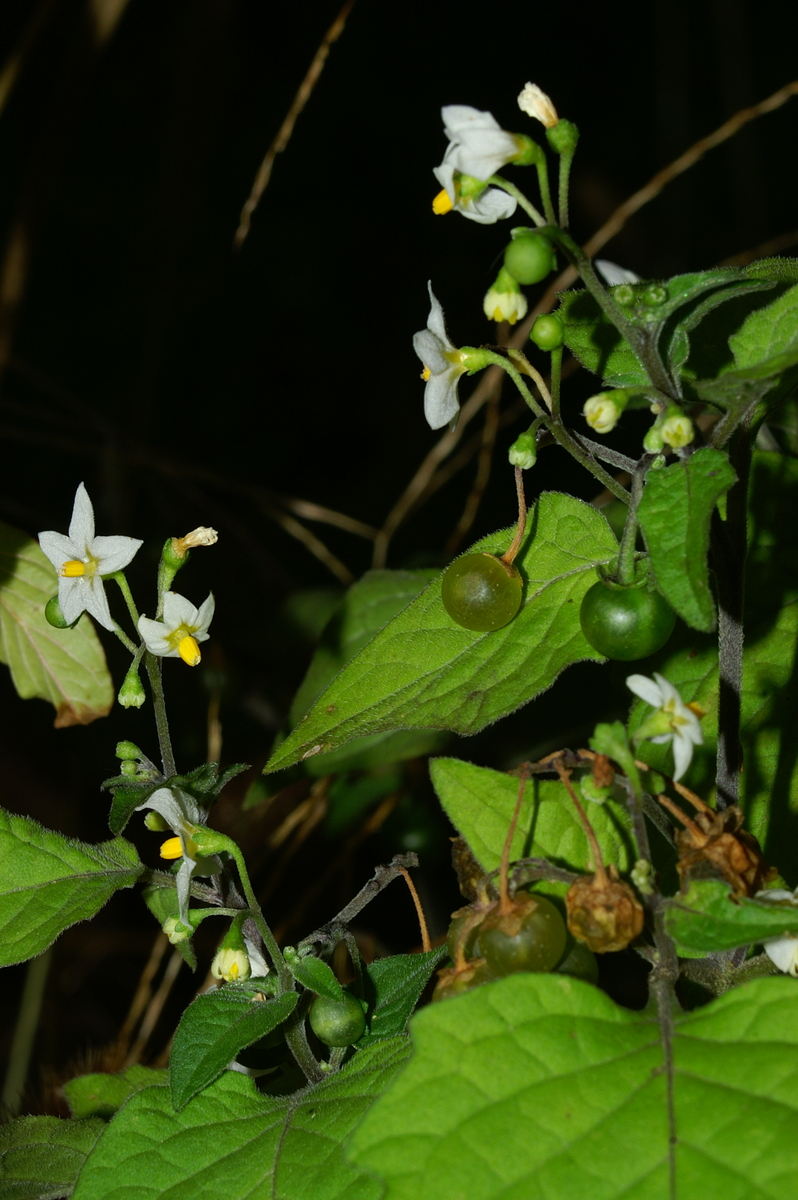

Solanum nigrum
black nightshade
Accumulation profile
- Substrate
- Contaminated agricultural soil
- Habitat
- Disturbed and cultivated ground
- Distribution
- Cosmopolitan (temperate & tropical)
- First reported
- 2026 · Norouzi et al.
- Verification
- primary-measured
Description & ecology
A common weed that hyperaccumulates cadmium on contaminated soil — attractive for remediation because it is fast-growing and easily cultivated, though the trait is population-dependent.
Promoted to primary-measured (2026-07-26): Norouzi et al. (2026, open access) measured shoot Cd rising with dose (35, 68, 115, 170 µg/g DW at 12.5–100 mg Cd/kg soil), a maximum of 170 µg/g that clears the 100 µg/g threshold. This is a soil-spiking pot experiment (an operational/facultative hyperaccumulator), not a field maximum.
References
- Norouzi, R., Baghizadeh, A., Abbaspour, H., Nematpour, F. S., & Safipour Afshar, A. (2026). Associations between cadmium uptake and leaf–root expression of candidate YSL/HMA transporters in Solanum nigrum. Scientific Reports, 16, 10062. doi:10.1038/s41598-026-41163-5
- Reeves, R. D., Baker, A. J. M., Jaffré, T., Erskine, P. D., Echevarria, G., & van der Ent, A. (2018). A global database for plants that hyperaccumulate metal and metalloid trace elements. New Phytologist, 218, 407–411. doi:10.1111/nph.14907
- Pollard, A. J., Reeves, R. D., & Baker, A. J. M. (2014). Facultative hyperaccumulation of heavy metals and metalloids. Plant Science, 217–218, 8–17. doi:10.1016/j.plantsci.2013.11.011