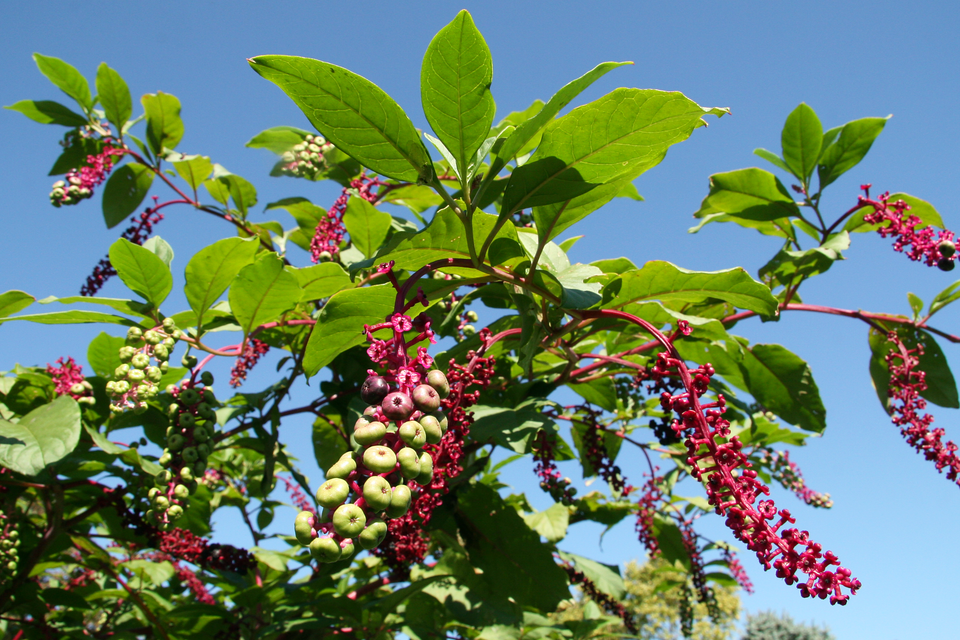

Phytolacca americana
American pokeweed
Accumulation profile
- Substrate
- Contaminated and manganese-rich soils
- Habitat
- Disturbed ground
- Distribution
- North America, naturalised in East Asia
- First reported
- 2008 · Peng et al.
- Verification
- primary-measured
Description & ecology
VALUE AS STATED AT SOURCE (Peng et al. 2008, J. Hazardous Materials 154:674–681, abstract read at PubMed PMID 18068296): field plants on contaminated soils in Hunan, South China, reached 'a maximum 13,400 mg kg−1 in the leaves' Mn (leaf mean 2,198; root mean 80.4 mg kg⁻¹), with a significant leaf–soil Mn correlation.
CORRECTION 2026-09-13: the previously listed Cd max of 130 µg/g was REMOVED — it is absent from the paper's abstract and no accessible source confirms it, while a citing paper quotes Peng et al. 2008 as showing leaf Cd up to 408 µg/g (hydroponic, 5,000 µM Mn + 50 µM Cd; Liu et al. 2010, Chemosphere 78:1136–1141) and another claims '>0.24% Cd' (likely erroneous). The paper does document foliar Cd hyperaccumulation in hydroponics, but no verifiable maximum: the Cd value is therefore retired to this note rather than kept as a database figure. (Record id retains '-cd' for URL stability.)
The same plant is also a rare-earth accumulator (see the separate P. americana REE record).
References
- Peng, K., Luo, C., You, W., Lian, C., Li, X., & Shen, Z. (2008). Manganese uptake and interactions with cadmium in the hyperaccumulator — Phytolacca americana L.. Journal of Hazardous Materials, 154, 674–681. doi:10.1016/j.jhazmat.2007.10.080
- Reeves, R. D., Baker, A. J. M., Jaffré, T., Erskine, P. D., Echevarria, G., & van der Ent, A. (2018). A global database for plants that hyperaccumulate metal and metalloid trace elements. New Phytologist, 218, 407–411. doi:10.1111/nph.14907